Scotland vs Afghanistan, 2024 T20 World Cup
Warm-Up Highlights: Afghanistan kicked off their T20 World Cup preparations
with a 55-run thrashing of Scotland in a warm-up game at Port of Spain on
Friday,
Scotland vs
Afghanistan, 2024 T20 World Cup Warm-Up Highlights: Afghanistan kicked off
their T20 World Cup preparations with a 55-run thrashing of Scotland in a
warm-up game at Port of Spain on Friday. After opting to bat, Afghanistan
powered their way to 178/8 in 20 overs, with Gulbadin Naib smashing 69 off just
30 balls. Azmatullah Omarzai also chipped in with 36-ball 48 before captain
Rashid Khan played a cameo of 15 from seven balls. In reply, Scotland were
restricted to 123/9 by the Afghanistan bowlers
Eisenhower Park’s 34,000 seats could have been sold out many times over for India v Pakistan and no doubt will be pretty full for India’s other group games against Ireland and the US. However, it is worth remembering the venue is hardly Manhattan, rather 30 miles east of the city centre. How many fans wish to take that journey through rush-hour traffic for Ireland v Canada and a 10.30am start remains to be seen.
It is the US, Canada, Uganda and Papua New Guinea that bring the real intrigue, colour and stories to the tournament. It could be argued – and may well prove to be true – that their presence will result in some mis-matches, but cricket is now mirroring football and rugby in inviting the entire planet to a World Cup. Twenty teams is the biggest cricket World Cup of any kind.
One of the many problems with the 50-over World Cup is it is simply a re-run of match-ups we see over and over. Even in T20 cricket, you might feel like you have witnessed England play West Indies or Pakistan umpteen times in recent years. But 43-year-old Uganda spinner Frank Nsubuga bowling to Kane Williamson? Yes, please. Bring on another Dwayne Leverock moment.
The seemingly endless treadmill of franchise tournaments is a pretty credible stick with which to beat the shortest format of the game, though there is no denying that T20 is spreading the sport across the planet. Oman, Nepal, Namibia and Scotland will probably never play a Test, yet here they have an opportunity to compete on the grandest stage.
The teams outside of the elite will fancy their chances of landing some blows on the big boys. Ireland, cricketing giants compared to some of the nations competing, beat eventual champions England two years ago in Australia. The Netherlands caused chaos in the 50-over tournament in India and the US have just won a series against Bangladesh. Further up the food chain, Afghanistan will think they can muscle into the last eight.
There is also a purity to the T20 World Cup that sets it aside from domestic competitions, which are often just the same players shuffled into different coloured shirts. There will be no impact subs, no revolving door of overseas players jetting in and out from other leagues, just the best players trying to win a World Cup for their country. The stop-clock between overs should keep the action bumping along, too.
Cricket being cricket, there are some imperfections and idiosyncrasies.
As has become the norm, the draw is arranged so that fierce rivals England and Australia, and more lucratively, India and Pakistan meet in the first round. No other major team sport would take this approach.
The schedule is chaotic, with matches commencing at all hours and the only pattern to start times is a desire to satisfy Indian TV audiences. If they get through, India already know which semi-final they will play and the final in Barbados on 29 June gets under way at 10.30am local time.
Defending champions England are in the weaker half of the draw, under pressure after a feeble defence of their 50-over world title. A semi-final spot feels a minimum requirement to calm speculation over the futures of captain Jos Buttler and coach Matthew Mott.
The top-order looks exciting and the return of Jofra Archer is a massive boost to the potency of the bowling attack. There is the subplot of Jonny Bairstow and Phil Salt chasing the wicketkeeping spot in the Test side and the prospect of a last global event for some of the golden generation that made England double world champions.
With just two matches possible in the series against Pakistan and little T20 cricket since the last World Cup, England could be undercooked, though the Indian Premier League has disrupted the preparations of others, too.
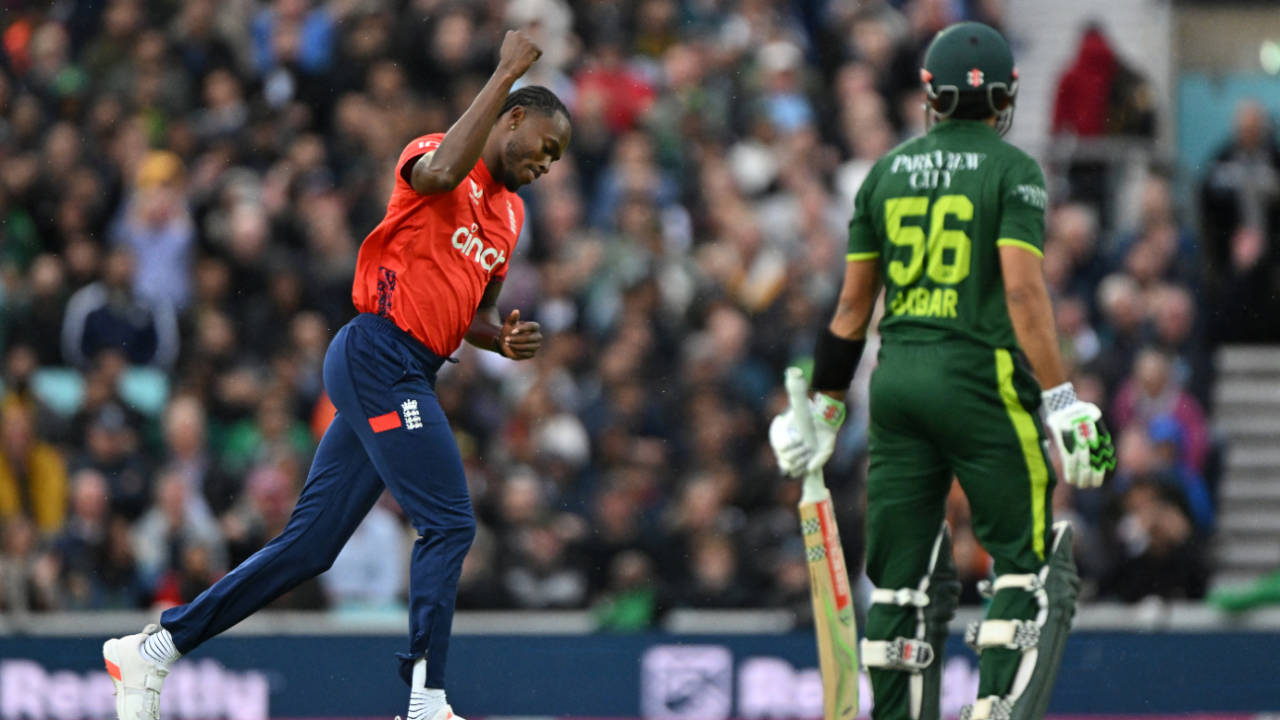
Jofra Archer celebrates the wicket of Babar Azam • Getty Images
England 158 for 3 (Salt 45, Rauf 3-38) beat Pakistan 157 (Usman 38, Livingstone 2-17, Rashid 2-27, Wood 2-35) by seven wickets
There wasn't much to separate these two sides when they met in the last T20 World Cup final, but in the final T20I before that tournament's next edition kicks off, the gap between the two is positively chasmic. A disciplined, all-round bowling performance from England, followed by a brutal barrage of top-order hitting from openers Butller and Salt saw England crush Pakistan by 7 wickets with 27 balls to spare, and claim a 2-0 series win.
How the game started under overcast skies wasn't quite a harbinger of the overwhelming dominance England would eventually establish. Babar Azam and Mohammad Rizwan, who opened the batting for the first time this year, got Pakistan off to a steady start in the first four overs before finishing the powerplay strongly; the 59 they managed was Pakistan's second-highest powerplay score since January. But England struck back with five wickets for 27 runs either side of a brief rain break, spearheaded by Rashid.
Brief, happy-go-lucky resistance from Usman Khan whose 21-ball 38 bolstered Pakistan when they were in danger of crumpling - kept hopes of a competitive target alive for long enough. But Liam Livingstone, who England utilised to perfection in the middle overs, prised him out thanks to a stunning catch from Chris Jordan, and Pakistan eventually folded for 157.
There was a suspicion it wasn't quite enough, but England's openers made a mockery of the idea it was ever even in doubt. Mohammad Amir was leathered for 16 in his first over, Naseem Shah pulverised for 25. England scored 78 in the Powerplay, their highest since they managed 82 in Lahore against the same opposition in 2022. And though Haris Rauf restored some respectability to the score with three wickets in a fiery, spirited spell, the hosts wouldn't even let him have the last laugh, with Harry Brook clobbering him for six over cover to seal a statement-making win before their World Cup defence begins.
Rashid triggers collapse,
Rizwan and Babar had given Pakistan a platform, but what happened off the final ball of the powerplay was more significant than anything that went before. The Pakistan captain edged one to short third, which Rashid held on to. The openers have often been accused of slowing down after the powerplay, so when Rashid breached Rizwan's defences next over, the middle order had their platform laid out for them. But Fakhar Zaman holed out as Rashid took a sharp catch during a passage of play when he simply couldn't be kept out of the game. He returned to clean up Shadab Khan first ball, with Mark Wood's sheer pace sending Azam Khan packing for a five-ball duck. His nightmare was only just beginning.
Livingstone's bowling heroics
Every time Livingstone was thrown the ball by Buttler, it seemed like the time for Pakistan to sneak in a big over. And yet, the spinner found a way to bowl perfect lines to perfectly set fields; the big shot never quite seemed to be on. But not content with being milked for 16 in his first two, Livingstone bowled the most impactful over of the game in the 15th, sending down a double-wicket maiden. Pakistan's top-scorer Usman holed out to Jordan before Shaheen Afridi smeared at one that eventually hit his stumps. By the time Livingstone was done, the last dregs of Pakistan's batting resistance had been stomped out of them.
The onslaught
On a wicket as true as this, surely Pakistan's pace quartet would find a way to keep England honest, right? Right?
Wrong. Shaheen and Naseem might have been slightly unlucky to concede 18 without reward in the first two, but everything that followed was a one-sided drubbing. Even the pace of the wicket played in the batters' favour, the touch and timing of Buttler and Salt meaning caresses flew to the boundary. Pakistan's bowlers, flustered and harried, found their lengths wavering and their pace one-dimensional. It was only too easy for England's openers to take full advantage.
Azam's day out
Azam receiving a snorter of a short ball he wasn't mobile enough to evade was just the start of his horror day. With his credentials as a middle-order batter severely diminished by his stint in the side, his status as their wicketkeeper also took a battering. Stationed there only because he can't be hidden elsewhere, he dropped two straightforward chances off an otherwise impressive Rauf, with his embarrassment so palpable it was borderline uncomfortable viewing. When he eventually did grasp a straightforward catch, Rizwan jogged up to give him a pat on the back. You would imagine it isn't long before Rizwan is stood there permanently again.
Middle order implosion after dismissals of Babar and Rizwan sets off familiar cycle of recrimination,
Pakistan have spent 2024 kidding themselves - but just about nobody else - that they would break up the most prolific opening partnership in T20 international history. for their first match of the year, Rizwan and babar azam took it in turns to slide down to No. 3, giving Saim Ayub - and, briefly, Haseebullah Khan - opportunities to open the batting.
But at The Oval, they made the change that was nothing short of inevitable. Ayub was one of the players of the tournament at last year's Caribbean Premier League but, one game before the t20 world cup, he was dropped. His 12 T20I innings this year have brought him 163 runs at just 13.58 and his last four opening stands with Rizwan were worth 7, 6, 16 and 0
It meant a return for the pair who have scored more heavily than any other in this format: Rizwan and Babar, reunited at the top of the order. It is impossible to question the volume of runs they have scored together: they are the only pair with 2000runs partnership, with an average stand of 49.18. They have put on 100 or more eight times; nobody else has managed more than four.
Yet they have always managed to split opinion in Pakistan, and you can be certain that they will do so once again when they arrive in the United States this weekend. For the most part, they are immensely popular: there is even a Wikipedia sub-entry for "RizBar fandom". It is their scoring rate as a partnership - 7.98 runs per over - which invites regular criticism.
They have become even more restrained at T20 World Cups: Babar's strike rate in his two World Cups is 114.47, while Rizwan's is exactly 120. For every partnership like the unbroken 152 to beat india by 10 wickets, there has been a stand of 71 in 10 overs in an under-par total in the 2021 semi final Australisa defeat them by 5 witckets,
This was the sort of innings that both players might see as justification for their tendency to lean towards cautiousness.Pakistan resolved to play with more attacking template after their defeat to Ireland earlier this month, and scored at more than 10 runs per over in consecutive run chases to win that series 2-1.
But they have long preferred chasing to batting first, and this was a performance which highlighted why. Rizwan and Babar made an uncharacteristically fast start against some hostile new-ball bowling: Mark Wood hit 96mph/154kph and Jofra Archer passed 90mph/145kph, but both conceded early boundaries. When Babar failed to capitalise on Archer's width, he threw his head back in frustration.
And when Jos Buttler threw the ball to Moeen Ali for the fifth over, as though dangling a carrot, Babar bit it clean off the string: he charged down to the first ball of offspin he faced, lofting Moeen into the lower tier of the pavilion. Rizwan shimmied around in his crease, looking to unsettle the bowler, and dabbed delicately past short third.
After Babar slapped Archer through the off side for back-to-back boundaries, Pakistan were 59 for 0 with a ball left in the Powerplay - their highest opening stand of the year, and the highest since this pair were first broken up. So when Babar steered the final ball of the sixth over - Archer's legcutter - straight to short third, it did not take much foresight to work out what would happen next.
Rizwan fell four balls later, clean bowled by a ball that didn't spin from Adil Rashid, and Pakistan's middle order subsided. Usman Khan, restored at No. 3, was the only man to make an impact, hitting three fours and two sixes in his 21-ball 38. The rest fell away against Rashid and Wood, with Azam Khan's five-ball duck - which culminated in gloving behind a bouncer, via his shoulder - the lowlight.
When Haris Rauf was run out off the penultimate ball of the innings, Pakistan had been bowled out for the second match in a row and had turned 59 for 0 into 157 all out. No wonder Rizwan and Babar prefer to do the hard work themselves, if that is all the middle order behind them can muster. It is a classic case of self-perpetuation.
Rizwan and Babar bat deep, which means the middle order rarely get the chance to face many balls; when they do, their dearth of recent opportunities means they underperform. That, in turn, means that Rizwan and Babar feel the need to get things done themselves; and the middle order's opportunities are limited once again. What came first, the chicken or the egg?
And so, Pakistan head to the World Cup with the same old opening pair and the same old problems. Over the next four weeks, they will probably beat a team they shouldn't. They will probably lose to a team they should beat. They will probably end up making it to the Super Eights, and probably even to the semi-finals. This is another season of the same show.
the upcoming season in 2025 - the tenth edition - the "last six-team event".
While this had been likely from the day the PCB and the PSL franchises agreed not to add further teams until after the tenth season, this is the first time the PCB has publicly confirmed the PSL expansion. Multan Sultans' entry in 2018 has been the only addition to the original five so far. The process for deciding which cities the new teams represent has not begun yet.
The year following the tenth season is potentially one of sizeable flux and jeopardy for the PSL, with the ten-year lease ownership agreements the PSL reached with franchise owners expiring in 2025. ESPNcricinfo understands Sultans' lease is also up for renewal next year, despite them joining the PSL two years after the rest. All six owners have right of first refusal, meaning ownership of a franchise only goes up for sale in the event of a current owner declining to match the franchise's valuation.
What is more contentious, however, is when the PSL will be played from next season onwards. The Champions Trophy will be played in the traditional PSL window in February-March, and with the ILT20 and the SA20 cutting in on PSL territory, the PCB wants a more reliable window. Their current preferred solution is the move the PSL into April and May, carving out a six week window from April 7 to May 20 next year, and clashing directly with the IPL. More contentiously, the PCB aims to make this the PSL's permanent window rather than an ad hoc solution to a crowded calendar next year.
There is by no means universal agreement for this option. Most of the PSL franchises initially opposed the idea because of the implications it would have on player availability and the inevitability of playing second fiddle to the IPL, and at least three of the six franchises remain firmly opposed to it. A PCB official, though, told ESPNcricinfo they remain confident the franchises will come around to it. It is also worth noting that franchise opposition to the idea cannot necessarily stop it happening; those decisions are made by the PSL governing council. De facto, that means the PCB could decide to play the tournament in any window, with or without the support of the franchises.
The PCB has offered to tweak player recruitment rules and open up fiscal space to allow franchises to sign one marquee player independently of the draft to alleviate concerns around player availability. With their current broadcast partnership ending in 2025, the next season could effectively become a test case for the future viability of hosting the league at the same time as the IPL. In addition, the league's expansion to eight teams would have necessitated a larger window anyway, with the three-month window currently carved out for the IPL providing enough time for a slightly extended PSL.
However, this also necessarily means the PSL will effectively only have overseas players available to them who go unselected at the IPL, given the large financial disparity between the two leagues. This, for example, effectively rules out Rashid Khan turning out for the Lahore Qalandars - one of the franchises opposed to the window - for the foreseeable future. Qalandars opted to retain him for PSL 2024 despite knowing he would not be fit to ensure they would be able to keep the Afghanistan legspinner the following year. However, it is likely he would turn out for the IPL if the two leagues clash.
ESPNcricinfo also understands the PCB is seriously exploring the possibility of hosting the playoffs and final of PSL 2025 in the UK if this April/May window is finalised. Lahore is unseasonably hot in mid-May - temperatures are currently hovering in the mid-40s. The move to the UK, according to the PCB, does more than mitigate against the weather, though; it also globalises the reach of the PSL. The UK is also believed to be a more cost-effective option than the UAE, which has, in the past, hosted every PSL match that did not take place in Pakistan.